My host families’ house is located near the center of Cenac, right off only the only paved street in town. Our neighbors include the discoteca/culture house (a stout one room building with very pink walls), the basirica and the post office. Up the street a ways are two of Cenac’s main stores and the Mayor’s office. Across the street from the Mayors office is Cenac’s only school.
Also next to the Mayor’s office, in what might be described as the “town square,” is a small stretch of road where people wait to hitchhike out of the village. As I mentioned in my last entry, hitchhiking is widespread: in my village, for instance, probably as many people hitchhike and carpool as own cars - probably more. When I walk through central Cenac, no matter the time of day, I’m likely to see villagers of all ages waiting for a car to Cimislia, the county center. Many are students on their way to school or older people buying produce. Like anywhere else in the world, people have to run errands. In Cenac, 10 lei (a little less than a dollar) is the understood toll for getting there.
Cenac’s only bus leaves for Cimislia once every day, in the morning. If a Moldovan misses that bus, she waits for a passing car. It’s partly due to these kind of transportation issues that the phrase “time is of the essence” isn’t in the Moldovan lexicon. Far from it. Punctuality seems like a foreign concept. (Luckily, punctuality isn’t expected either. Stopping for a 45 minute lunch at 1:50 PM on the way to a 2:00 PM meeting is entirely acceptable. People have to eat after all!).
For Americans in Moldova, this takes some adjusting to. Errands that might take a single morning in the United States often take a full day here. What would be daylong tasks take several, three-day tasks a week, weeklong tasks….well, you get the picture.
When I first got to site I would often ride with my host father into town, instead of taking the bus. “Domnul (Mr.) Ion,” I’d say, “I’m leaving for Cimislia tomorrow morning.”
“Yes? With who do you go?”
“With the autobus.”
-Waving dismissively- “Go with me tomorrow. I go to Cimislia.”
“Thank you Domnul Ion. But what time will we leave? I must be in Chisinau (the capitol) early. If you have other things to do I will take the bus. It is no problem”
-Hearty laughter- “We will leave at 9AM. There is no doubt.”
The next day.
9:30AM
Outside, Domnul Ion approaches.
“What are you doing here Mat? Soon, we have left.”
“OK Domnul Ion. Tell me when you are ready.”
10:30AM
Domnul Ion walks toward the car. Excellent, I think. I call out. “We are leaving now, yes?”
He turns to me, “No. Măt! You stay here! I must go to the tractors. I will come soon. And soon we have left.”
11:30AM
“Măt! Let’s go! We have left!”
11:45AM
The car stops outside the Mayor’s office.
“Măt! You stay in the car. I have to do one thing here. Soon we have left.”
12:00PM
We drive into the middle of some field and stop.
“Măt! You stay in the car. I must check the grapevines here.”
12:50PM
Finally, we pull into Cimislia’s bus station, “See! We have arrived early! Call me when you return and I will come for you!”
“Thanks Domnul Ion.”
Despite knowing that I’d arrive at my destination 2-3 hours later than intended, I repeated some version of this episode several times early in my service. It was difficult to get used to, if only because he so emphatically insisted that I go with him instead of taking the autobus. But I would learn in time, and something I should have realized earlier, is that his insistence was borne of his hospitality. It’s his nature. He did not want me to have to take the public bus if he could help me himself. Indeed, he was providing me with a service most volunteers go without, and one which I, and few Moldovans, rarely are able to take advantage of. He assumed I could wait because a service like that was so rare. In a situation like this, time is not of the essence.
Still, it wasn’t long before I began taking the morning bus.
Showing posts with label Peace Corps. Show all posts
Showing posts with label Peace Corps. Show all posts
Monday, June 27, 2011


Saturday, June 25, 2011
Little House

On the surface, village life isn’t quite Little House on the Prairie. Life can be difficult. Luxuries are scant, paying jobs are scarce and money is hard to come by. The winter is cold, and wood fires, used to heat the houses, do little to warm winter nights. Strange odors permeate. Roads are unpaved and muddy. Infrastructure is dilapidated.
And yet, one doesn't have to search much to find the quaint aspects of life that inspired myths like Little House. People are neighborly – it’s rude not to say “good day” to someone on the street, even to someone you haven’t met before. If you have met the person, it’s expected that you stop and talk (Imagine if you had to stop and talk to every one of your neighbors you saw every day. My bet is you probably don’t, I know I didn’t). These discussions add to Cenac’s personable nature. Romanian is an old language, and can sound almost gallant, reflecting a more gracious time, long past (“Good day, sir. I am called Matt, what do they call you? It is my pleasure.”)
Furthermore, mutual difficulty inspires a communal approach to addressing problems. For example, Cenac has communal clean-up days (it’s different from volunteer park clean-ups in the States. Moldovan villagers feel obligated to participate, as opposed cleaning up out of a sense of civic duty. There is a subtle difference). Birthday parties, or masa’s, are hosted by whoever’s birthday it is, and he/she prepares the food and drink for people attending. Villagers also share resources we normally would consider private, valuables that we might hesitate to lend out in the United States.
Another good example of Moldova’s communal approach to solving problems is hitchhiking, one of the main modes of transportation not only in the rural villages, but all over Moldova. In the United States, hitchhikers are the exception, and most people I know would hesitate to pick one up. Not in Moldova. If a Moldovan has an open seat in his car, and he sees a hitchhiker (he invariably will, and at multiple points during his journey), he stops without a thought to pick them up.
In the spring and summer, when flowers bloom and cherries blossom, Moldova can be picturesque. Right now, for instance, I can literally walk out of my room and eat fresh cherries, raspberries, strawberries and prunes. If I go into the garage, I can sample some of the freshly harvested, high quality honeycomb. If I wait another month, the watermelons will be ripe, and we will eat between 2 and 3 a day. Sounds amazing right? It is. But it’s also only 3 months of the year. During the winter, fresh fruits and vegetables are nearly impossible to come by. Instead we eat pickled versions that we spent the summer and fall preparing: Pickled tomatoes, pickled cucumbers, pickled cabbage, pickled peppers, and, yes, pickled watermelons. By mid-February you’ll have trouble telling them apart.
So yes, like anything else on TV, mass media romanticizes what rural village life is actually like. That doesn’t mean that villages aren’t quaint and can’t be great places to live. It just means that, much like the Peace Corps, village life isn’t a vacation. The secret to unlocking the real Little House is hard, back-breaking work. It’s a lifestyle that’s difficult to grasp through the Hollywood prism. But Moldovans know where to find it, at the end of a hot summer day, amidst the sunflowers and cherry trees.
Tuesday, April 5, 2011
The Final Countdown
I have seniortis. Of course I'm still dedicated to work - I'm busier now than I ever have been in fact - but I increasingly find my mind drifting to subjects related to home.
Often these thoughts focus on food. Chipotle, sushi, Indian buffet, delivery pizza and all you can eat wings, the list goes on, but it's safe to say that if the American Heart Association would have it blacklisted, I miss it.

Coma-inducing meals aside, what I REALLY miss about American cuisine is variety. No, not 'stale variety' (sorry, couldn't resist). That one can find foods from all around the world (including, I'm sure, Moldova) is one of many great things about America's cultural diversity. In fact, when I get back, I'm hoping to travel up the East Coast in pursuit of some of my favorite meals - my ma's home cooked meals (how's that for a suck up?) Indian buffet and Five Guys in Northern Virginia; deli sandwiches and pizza in Jersey; pretzels, Chinese and Italian gourmet in New York; late night and tailgate food in State College; hell, maybe I'll even make it up to Boston for the sea food. I've lost ten pounds in Moldova and I was already a thin guy before. It's time I start making up for lost time.
Other things beckon, among them family, friends, and hopefully a paying job. I have a fantasy football league to rejoin and college football games to attend. But, sometimes, the thought of readjusting to the hubub of American life and all of the things I'm hoping to do can be overwhelming. I've heard stories of returned volunteers having panic attacks in supermarkets and large crowds, for example. I don't expect that to happen to me, but does anyone really expect it?
The excitement of my first few weeks or months stateside will of course ebb into the daily grind. I'm sure then I'll find myself missing many of the things I've come to appreciate about Moldova. One has a sense of value living in a small tight-knit community, and I don't think there are many places in America where one can feel more anonymous than Washington D.C..
With that in mind I'm going to try to make the most of my last few months here. The United States may be looming ever larger in the back of my mind, but it's important for me to focus the rest of it on finishing strong.
Saturday, April 2, 2011
Pictures from PST

Well it's that time of year again, the Moldova 26's have been chosen and the volunteers here are eagerly awaiting their arrival. I realize that a lot of the traffic on this blog is from soon-to-be volunteers, so I'd like to say congratulations! Here's a post dedicated to you.
I'm sure you're hoping to get a sense of what your first few months in Moldova will be like,and I encourage you to go back and read some of my earlier posts. Here are some pictures from my training I never got around to posting.
These pictures were taken during my host sister's birthday celebration. A hot saturday afternoon in August, we went to a lake and danced, ate food, sang, and played sports. This is typical for all kinds of celebrations in Moldova - they never miss a chance to take advantage of the good weather!


Next, some pictures are from the M24 Community Development training village. Not only was the village beautiful and friendly (most of us had exceptional host families), it was a great location to learn about the culture in the rural countryside.

One of the village's two Orthodox churches, known as a basirica. Typically the basirica is the most ornate building in a Moldovan village

Location of the Vasieni basketball match

In most villages you can find shrines, crosses, and other religious symbols placed periodically around the village and next to water sources like wells.


Farmland and rolling hills stretch as far as they eye can see

This was my host families outhouse. No explanation required.

Most households in the village have fenced in properties. The family spends a lot of time in the courtyard, and much effort is put into making sure it's clean, orderly and organized.

We lived in our training village with different host families, and also living there were our language and cultural facilitators, or LCF's (one of many acronyms you'll learn as a "PCV"). We had language lessons four hours a day, for six days a week at the local school, as well as technical training twice a week at a school in the regional center.

Pre-Service Training might have been a summer of strenuous work, but it was extremely rewarding work. I learned a new language, made new, lifelong friends (both Moldovan and American), and became acquainted with a culture I had known little about. So to all of the new volunteers coming in, good luck, şi e bine că veniţi!
Friday, April 1, 2011
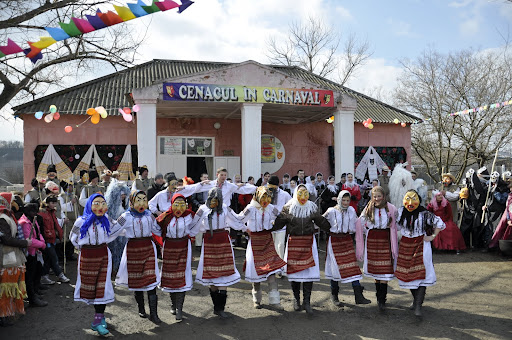
More on Festivalul Măştilor
I realized that my last post didn't really do Festivalul Măştilor justice. Here are some pictures and an awesome video of the festival, courtesy of Lucas and his colleagues from the European Voluntary Service. Check out Lucas' blog @ http://enmoldaquoi.blogspot.com/
Ambushed

The Carnival organizers


HORA

Performance at Casă de Cultura, (Culture House)



Friday, February 5, 2010
Lessons in Cultural Diffusion
It had been a long day - again. After 7 hours of lessons and briefings in Ialoveni, the sauna-like routeira back to Vasieni was the icing on the cake. Looking around at the gaunt faces of my fellow travelers, it was obvious. The one thing we all needed happened to be something Moldova had plenty of – beer. Quickly passing the word, we decided to meet at a “bar” run by a volunteer’s host mother.
Now, in Moldovan villages, bars don’t exist in the sense they do in the United States. Rather, they are all purpose stores which happen to serve lots and lots of alcohol. Occasionally you’ll find some stools to sit on, and a table to sit at. You couldn’t ask for much else. In Moldova at least.
We all went and had a beer or two. A few of us a couple more, but it was late in the day, and we were tired, so after an hour or two volunteers started trickling back to their host families. More time went by, more volunteers left, until only a few of us remained, surrounded by a mountain of beer bottles. The rest of us cleaned up and left, mostly heading home.
What happens when 13 Peace Corps Volunteers drink one bottle of beer? That’s right, same as in America, you get 13 empties. Let’s say they all drink two? 26, bravo! A few others drink some more, and the count reaches into the 30’s. That’s a lot of empty beer bottles, but two beers a person is hardly excessive (it’s probably just about right, a beer is about 50% larger in Moldova than in the States). Unfortunately, being foreigners, and being American (a.k.a. loud), we attracted attention.
No one complained to us directly, so it wasn’t until the next morning that we heard about there being a problem. During class, we were confronted by our LCF’s, who had heard from multiple sources that the Americans had gone on a binge at the bar, had made a ton of noise and left a mess to be cleaned up. “It isn’t good to leave the impression that you drink a lot,” our LCF’s scolded us.
Being the ‘Honest Abe’ I am, or maybe just a simple braggart, I made the mistake of admitting in class that I had drunk 5 beers myself. Responding calmly, my LCF helped me figure out, in a painstakingly slow equation akin to torture, exactly how much alcohol I had consumed that night. In Romanian. You try that hungover.
Some of us were a little dumbstruck. There were 13 of us – of course there had been a lot of beer. And I thought we had done well cleaning up after ourselves. We just hadn’t gotten used to the fact that, in essence, we were all living in a fishbowl. No matter how many times you are told about it, from other volunteers and trainers, it doesn’t actually prepare you for the sensation of constantly being judged (maybe High School does, but few other things). 13 Americans in a village that had hardly seen any before was certainly going to attract scrutiny. It didn’t matter how much each individual drank – 30 bottles is still 30 bottles.
It reminds me of something that happened to some of the other COD volunteers a couple of weeks into training. Walking to and from the school every day, we would be stopped by the odd villager and asked questions.
“Who are you?”
“Where are you going?”
“Why are you here?”
“Ce faci in Moldova????”
Most of the time it was pretty innocent, and we were happy to practice our emerging Romanian skills. So, when one of the volunteers was asked to play basketball by one of the local kids, he accepted without a thought. Bring a couple of your friends, the kid had requested. Setting a time, the volunteer went to class and recruited a couple other COD’s to meet him at the basketball “court” later that day.
During the assigned time, I was picking cherries with my host family (yea, laugh it up), so I unfortunately missed the spectacle that followed. In short, the volunteer had unwittingly agreed to an apparently earthmoving match-up between Moldova and America, when he had thought he had been agreeing to a small pick up match between some kids from Vasieni and a few out of shape volunteers. Half the village showed up, complete with cheering girls and old men drinking outside the fence. Scrawled in big red chalk on the side of the building was “MOLDOVA WIN”. Standing in the middle of the dirt court, looking at the crooked hoops, bouncing around the soccer ball that was to be their adhoc basketball, I’m sure the volunteers were wondering what they had gotten themselves into (Inconsequentially, they ended up losing the game. But really, only because the Moldovans were in incredibly good shape. Plus they didn’t play by the rules, I mean you can’t tackle people in basketball, right? And how come there was no time limit?? We couldn’t play forever, you know!).
These aren’t stories about miscommunication. They’re stories that encapsulate the unique experience it is to be an American volunteer in a foreign country. It may sound arrogant, but there is an undeniable buzz surrounding your presence. You may have to get used to the scrutiny, the criticism, and even some ignorance in order to do your job right, but it’s exactly that attention which empowers volunteers to do their job at all. People are interested in what you are doing, and why you are doing it.
If you’re good enough, you may just be able to sell them on it.
Now, in Moldovan villages, bars don’t exist in the sense they do in the United States. Rather, they are all purpose stores which happen to serve lots and lots of alcohol. Occasionally you’ll find some stools to sit on, and a table to sit at. You couldn’t ask for much else. In Moldova at least.
We all went and had a beer or two. A few of us a couple more, but it was late in the day, and we were tired, so after an hour or two volunteers started trickling back to their host families. More time went by, more volunteers left, until only a few of us remained, surrounded by a mountain of beer bottles. The rest of us cleaned up and left, mostly heading home.
What happens when 13 Peace Corps Volunteers drink one bottle of beer? That’s right, same as in America, you get 13 empties. Let’s say they all drink two? 26, bravo! A few others drink some more, and the count reaches into the 30’s. That’s a lot of empty beer bottles, but two beers a person is hardly excessive (it’s probably just about right, a beer is about 50% larger in Moldova than in the States). Unfortunately, being foreigners, and being American (a.k.a. loud), we attracted attention.
No one complained to us directly, so it wasn’t until the next morning that we heard about there being a problem. During class, we were confronted by our LCF’s, who had heard from multiple sources that the Americans had gone on a binge at the bar, had made a ton of noise and left a mess to be cleaned up. “It isn’t good to leave the impression that you drink a lot,” our LCF’s scolded us.
Being the ‘Honest Abe’ I am, or maybe just a simple braggart, I made the mistake of admitting in class that I had drunk 5 beers myself. Responding calmly, my LCF helped me figure out, in a painstakingly slow equation akin to torture, exactly how much alcohol I had consumed that night. In Romanian. You try that hungover.
Some of us were a little dumbstruck. There were 13 of us – of course there had been a lot of beer. And I thought we had done well cleaning up after ourselves. We just hadn’t gotten used to the fact that, in essence, we were all living in a fishbowl. No matter how many times you are told about it, from other volunteers and trainers, it doesn’t actually prepare you for the sensation of constantly being judged (maybe High School does, but few other things). 13 Americans in a village that had hardly seen any before was certainly going to attract scrutiny. It didn’t matter how much each individual drank – 30 bottles is still 30 bottles.
It reminds me of something that happened to some of the other COD volunteers a couple of weeks into training. Walking to and from the school every day, we would be stopped by the odd villager and asked questions.
“Who are you?”
“Where are you going?”
“Why are you here?”
“Ce faci in Moldova????”
Most of the time it was pretty innocent, and we were happy to practice our emerging Romanian skills. So, when one of the volunteers was asked to play basketball by one of the local kids, he accepted without a thought. Bring a couple of your friends, the kid had requested. Setting a time, the volunteer went to class and recruited a couple other COD’s to meet him at the basketball “court” later that day.
During the assigned time, I was picking cherries with my host family (yea, laugh it up), so I unfortunately missed the spectacle that followed. In short, the volunteer had unwittingly agreed to an apparently earthmoving match-up between Moldova and America, when he had thought he had been agreeing to a small pick up match between some kids from Vasieni and a few out of shape volunteers. Half the village showed up, complete with cheering girls and old men drinking outside the fence. Scrawled in big red chalk on the side of the building was “MOLDOVA WIN”. Standing in the middle of the dirt court, looking at the crooked hoops, bouncing around the soccer ball that was to be their adhoc basketball, I’m sure the volunteers were wondering what they had gotten themselves into (Inconsequentially, they ended up losing the game. But really, only because the Moldovans were in incredibly good shape. Plus they didn’t play by the rules, I mean you can’t tackle people in basketball, right? And how come there was no time limit?? We couldn’t play forever, you know!).
These aren’t stories about miscommunication. They’re stories that encapsulate the unique experience it is to be an American volunteer in a foreign country. It may sound arrogant, but there is an undeniable buzz surrounding your presence. You may have to get used to the scrutiny, the criticism, and even some ignorance in order to do your job right, but it’s exactly that attention which empowers volunteers to do their job at all. People are interested in what you are doing, and why you are doing it.
If you’re good enough, you may just be able to sell them on it.
Monday, February 1, 2010
Pre-Service Training
From June to August in 2009, I and 12 other Community and Organizational Development volunteers lived and studied in the
Vasieni is a medium sized village by Moldovan standards. It has a listed population of 4,000 (although it is rule of thumb to reduce that number by at least ¼, and up to 1/3, due to emigration and registered residents working overseas), and is stretched out along a single, long paved road. Located in the Raion center of Ialoveni, it was the furthest training village from Chisinau, and probably the most rural.
Vasieni had been host to another training group something like 7 years ahead of us, and we gather that the previous group had not been very well received. We heard stories of discontent, and an unwillingness to accept Moldovan culture. Luckily, however, the evident failure of the previous group didn’t have much of an impact on our reception. While it was immediately evident that the locals had seen very few Americans in their lifetimes, the majority of us were received warmly into incredibly hospitable Moldovan homes. My gratefulness for this shouldn’t be understated; our first few weeks were pretty rough. If my host family hadn’t been so patient, curious and eager to make me feel at home, I am pretty sure I’d have been on a plane back to the
Also living in the village, with other host families, were our three wonderful Romanian instructors. Their official title, Language and Cross-Cultural Facilitators, encapsulated very little of what they did for us (everything, for the most part). Fluent in English, they were our window’s into this strange new world. Had to wash our clothes, but forgot the words? Call up Adriana. Had to set up a meeting with the Mayor for a community development project? Ask Diana. Wanted a private routierra to take us into Chisinau? Rodica is there to help. Whatever Peace Corps was paying them, I’m quite sure it wasn’t enough (Disclaimer: This was a joke. I am not criticizing Peace Corps or their salaries. In fact I have no knowledge of them. I am sure they are quite generous. Please don’t kick me out).
Yet, strangely, against all odds, it turned out that our instructors actually liked us. I’m happy to say that after three months of training, they became my first Moldovan friends, and good ones at that. While that doesn’t mean class was made easier (or homework, ahem), the fact that we were able to have candid discussions about language, culture and life not only made my life easier, but brought us all as a group closer together. For this I am thankful.
While this has turned out to be a very “thankful” entry thus far, it bears reason to take a moment to say why. In short, PST was no cakewalk, and we managed to turn it into a pretty good time. It’s an achievement worth noting.
Thursday, January 21, 2010
Lost
The moment of arrival in Moldova had a sort of surreal feeling to it. Knowing that this country was not only a former member of the Soviet Union, but would be our home for the next two years, inspired a strange mix of emotions. To combine that with burnt out exhaustion and jet lag, well, you get one hell of a potent mixture. So just a pointer for any would-be volunteers reading this - don't leave your wallet on the plane.
June 2009
We landed in the
Phone: check.
Ipod: check.
Passport: had to dig around a bit, but check.
Wallet: …God. Damnit.
A frantic moment of searching ensued. My wallet was missing. Of course this would happen. After spending several arduous moments processing the last time I had seen my wallet, I came to the conclusion that I must have left it on the plane.
Fucking predictable. Fucking convenient. Fucking miserable.
The last thing I needed was to lose the only money I had brought with me to
Making my way back outside, I looked over at the plane, and felt the blood rush to my head. It was beginning to roll away, to who knows where. Adrenaline and panic pushed away any thoughts of my hangover, and another volunteer and I ran to speak with one of the runway operators. Here, I would exchange my first words with a Moldovan.
Now, as conversations go, I’ve had more successful. In fact, I’ll go out on a limb and say that every previous conversation in my life has been more successful. Even the disaster that was the first time I seriously asked out a girl (the rejection wasn’t all that bad, but how was I to know that we were standing in a patch of poison ivy?). Suffice to say, this moment would become my primary motivation to study nightly during language training.
“Ce?” he asked as we came back out of the terminal.
Not having any idea what “ce” meant, and frankly not caring all that much, I blurted out a string of panicked words, probably along the lines of “stop that #$%#! plane! I need my #@$! wallet off that plane!”
Blank stare.
Right, this was
“LEFT WALLET ON PLANE. PLEASE STOP PLANE.”
The Moldovan lazily watched my wild gesticulations. With painful slowness, he looked from me, this wild-eyed maniac standing before him, to the plane, and then ever so slowly back to me.
Blanker stare.
Suddenly Peace Corps had become very, very real. “You have got to be kidding me,” I thought. In my heightened state of panic it seemed ridiculous to me that Peace Corps was actually serious about most Moldovans not speaking English. I began to think some very un-Peace Corps-like thoughts. Seeing as I didn’t speak Romanian, we had an obvious dilemma.
“This, he forgot this.”
A calm voice. A straightforward voice. Was that a hint of amusement? I turned and saw Ryne, the other volunteer who had come outside with me, pointing to his wallet and making motions as if dropping it.
Right. Smart.
The man, of course, immediately understood. As my chin dropped shamefully to my chest, he began hailing the pilots on his walky talky. The plane stopped, and the man started explaining (at least I think) the situation to the pilot. As we had some time to wait, I decided to calmly check my backpack pockets one last time.
You can probably guess what happened next. I’m not sure who designs these hiking backpacks, but for whatever reason they love putting pockets in the most absurd of places. There it lay, my prankster of a wallet, in an unchecked sidepocket, next my sunglasses. I slowly lifted it out of my pack and stared at it. The runway operator, still talking on the walky talky, stopped mid-sentence. The look on his face needed no translation.
“Sorry,” I shrugged.
The tension was broken by a loud burst of laughter. I turned. Ryne, of course. Ashamedly giving another shrug to my new Moldovan friend, I felt a sudden rush of relief, and turned around to head back into the airport.
“Great,” I recall thinking, as I joined the line of waiting volunteers “and I’m supposed to be here to help these people?”
Wednesday, January 20, 2010
Airplane
June - 2009
I forget which airline we took, which is unfortunate. Unfortunate because the free alcohol was a huge plus and, as a result, I can only describe my flight experience as being very, very drunk. This is a common result, I’ve discovered, when you mix (some) Peace Corps Volunteers and free booze.
Now, airlines are supposed to limit how much alcohol they give their passengers, for obvious reasons. I’ve always considered the idea to be logical. Any number of unsightly things may result from serving too much alcohol on a plane. However, for reasons undiscovered, we found our hostesses to be unusually liberal with these limits. Pleased by our good fortune, we took full advantage. Isaac and I took turns fetching armfuls of mini-bottles from cabinets in the back of the plane, distributing to those in need. I like to think that the hostesses couldn’t resist our charm, powerless to say no to these young, charismatic volunteers. More likely, especially considering my patchy memory of the time, it was pity that permitted us to get bombed over the course of our ten hour flight.
“Where was it they said they were going? Moldova?? No, for god’s sake don’t stop serving them. I don’t think you can spend two hours sober in that country, let alone two years!”
Luckily for the other passengers, volunteers are a mostly harmless group of folk, if not particularly quiet. Suffice to say, I didn’t sleep much during the flight.
If my flight to Istanbul could be summed up as “drunk,” then our ensuing layover in the Istanbul’s airport could be described as “miserable.” My stomach was hosting the Kentucky Derby. My head the Beijing Olympics. Suddenly everyone was my enemy. Diabolical airport authorities had specifically designed chairs for unsleepabilty. Those hostesses knew about this place, knew what they were doing to us. They could have at least warned us that Istanbul’s airport is the worst place on earth for hangover recovery. I couldn’t even muster a smile as wide-eyed asian tourists took pictures of us. A sight we were, I’m sure. 60 miserable looking Americans muttering angrily at the floor.
As time went on, I began to feel a little better. Nonetheless, while sleep may have come for some, it didn’t for me. We had 5 hours for another round of ‘let’s get to know each other.’ And, as sleepy and miserable as we felt, between the card games and the guitars, we did. We had only known each other for 3 days, but there was a sense of something in our conversations, a mutual apprehensiveness I guess, but also of understanding. Understanding that this was a trip unlike that which most of us had taken before, and it was sure nice to know that we weren’t doing it alone.
AYO Technology
I like thinking back to my first days and weeks in Moldova. Everything was such a blur, so overwhelming. Tired and mostly miserable, I'm not sure I understood it for the adventure it really was. Now, 6 months in and able to speak freely, things are more settled, if a bit more boring.
Some good news - I have a reliable connection to the internet. Better than reliable, it's DSL to rival the speed of any connection I've used in the States. We brought it in about a month ago and, despite connection difficulty's in some places of the village, it seems to work really well. I'll post some more thoughts concerning the internet and it's impact on my village later.
For now, though, I want to begin making up for a 6 month absence from my blog. I've kept a journal, on and off, and will make periodic posts of some of the more interesting entries I've made, and eventually catch up to where I am now.
Subscribe to:
Posts (Atom)