Stale Videos - Moldova Pre-Service Training

Friday, April 1, 2011

More on Festivalul Măştilor


I realized that my last post didn't really do Festivalul Măştilor justice. Here are some pictures and an awesome video of the festival, courtesy of Lucas and his colleagues from the European Voluntary Service. Check out Lucas' blog @ http://enmoldaquoi.blogspot.com/


Ambushed


The Carnival organizers


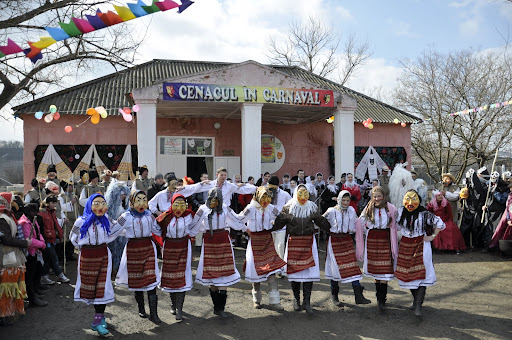
HORA


Performance at Casă de Cultura, (Culture House)


Thursday, March 31, 2011

Slipping into the Future

I can't believe it's been a year since my last post. I don't have regular internet access, which tends to sap my motivation, but I hope to update more regularly for my last few months in Moldova.

For now, an article/entry I wrote for 365 Day's of Peace and Friendship, a program run by PCV's to promote Peace Corps mission (world peace and friendship...). It gives PCV's a forum to share stories from their service.

March 22nd - Cenac’s Festival of Masks


During March in Moldova, the cold grips of winter steadily give way to the stirrings of spring. The coming of spring slowly brings physical transformation – snow melts, grass grows, birds sing, and the sun seems a bit brighter each day. For Moldovans, spring brings work, but it also brings fresh food, bonfires and fishing. Moldovans view the struggle of spring in March as a time for celebration, after what has usually been a long and cold winter.

Most Moldovan’s celebrate the season on the first of March, or Mărţişor. The village of Cenac in southern Moldova, my home for the past year and a half and my permanent site as a Peace Corps Volunteer, goes a step further. Every two years, drawing on several hundred years of tradition, Cenac celebrates winter giving way to spring during a festival known as Festivalul Maştilor, or the Festival of Masks. Unique to Cenac, it is a day of song, dance and wine with guests from all over the country. I attended this years’ festival and invited several other volunteers from the Peace Corps, along with a group from the European Voluntary Service to join in on the festivities.

While the opening ceremony began at 10 AM, the day started long before that. Early in the morning, children from all over the village donned traditional masks and costumes and combed the village, ‘inviting’ people to attend (a refusal is met with a handful of flour, so attendance is encouraged!). After the short opening ceremony in the center of town, a procession, including all participants, guests and onlookers and led by costumed performers, went on the move. From house to house throughout the village, musicians, singers and dancers performed for residents, who provided wine and snacks for the parade. This continued for the better part of an hour, after which we made our way back to the center and danced the Hora. Villagers dressed as skeletons, symbolizing winter, surprised the mayor, distracted as he was by the celebrations, and put him into a mock coffin, throwing it into the air.

Following the parade, we watched several performances – dances, songs and the occasional skit. The festival’s official end came in the form of a bonfire, which represented the passing of winter and the coming of spring. I and the other volunteers then attended a masa (meal) and discussed the festival and its traditional roots with the mayor.

Cenac is immensely proud of Festivalul Măştilor, and its residents relished the opportunity to share their unique tradition, for the first time, with guests from the United States, France and Germany. It’s a vivid example of how a simple action like attending a traditional festival can go a long way towards building world peace and friendship.

Tuesday, March 16, 2010

Making Wine with my Host Father

Here's a short video of my host father showing me how he makes house wine. It's not the full process, and it's in Romanian, but you'll get the idea. I made the video for a presentation we had to give Peace Corps on our villages in October. It's less informative, and more to give a bit of an idea of my family life in Cenac.

Domnul (Mr.) Ion has 5-6 big barrells of the stuff in the basement, and makes an enormous amount every year.

As you might guess, he's a popular man in the village


Friday, February 5, 2010

Lessons in Cultural Diffusion

It had been a long day - again. After 7 hours of lessons and briefings in Ialoveni, the sauna-like routeira back to Vasieni was the icing on the cake. Looking around at the gaunt faces of my fellow travelers, it was obvious. The one thing we all needed happened to be something Moldova had plenty of – beer. Quickly passing the word, we decided to meet at a “bar” run by a volunteer’s host mother.

Now, in Moldovan villages, bars don’t exist in the sense they do in the United States. Rather, they are all purpose stores which happen to serve lots and lots of alcohol. Occasionally you’ll find some stools to sit on, and a table to sit at. You couldn’t ask for much else. In Moldova at least.

We all went and had a beer or two. A few of us a couple more, but it was late in the day, and we were tired, so after an hour or two volunteers started trickling back to their host families. More time went by, more volunteers left, until only a few of us remained, surrounded by a mountain of beer bottles. The rest of us cleaned up and left, mostly heading home.

What happens when 13 Peace Corps Volunteers drink one bottle of beer? That’s right, same as in America, you get 13 empties. Let’s say they all drink two? 26, bravo! A few others drink some more, and the count reaches into the 30’s. That’s a lot of empty beer bottles, but two beers a person is hardly excessive (it’s probably just about right, a beer is about 50% larger in Moldova than in the States). Unfortunately, being foreigners, and being American (a.k.a. loud), we attracted attention.

No one complained to us directly, so it wasn’t until the next morning that we heard about there being a problem. During class, we were confronted by our LCF’s, who had heard from multiple sources that the Americans had gone on a binge at the bar, had made a ton of noise and left a mess to be cleaned up. “It isn’t good to leave the impression that you drink a lot,” our LCF’s scolded us.

Being the ‘Honest Abe’ I am, or maybe just a simple braggart, I made the mistake of admitting in class that I had drunk 5 beers myself. Responding calmly, my LCF helped me figure out, in a painstakingly slow equation akin to torture, exactly how much alcohol I had consumed that night. In Romanian. You try that hungover.

Some of us were a little dumbstruck. There were 13 of us – of course there had been a lot of beer. And I thought we had done well cleaning up after ourselves. We just hadn’t gotten used to the fact that, in essence, we were all living in a fishbowl. No matter how many times you are told about it, from other volunteers and trainers, it doesn’t actually prepare you for the sensation of constantly being judged (maybe High School does, but few other things). 13 Americans in a village that had hardly seen any before was certainly going to attract scrutiny. It didn’t matter how much each individual drank – 30 bottles is still 30 bottles.

It reminds me of something that happened to some of the other COD volunteers a couple of weeks into training. Walking to and from the school every day, we would be stopped by the odd villager and asked questions.


“Who are you?”

“Where are you going?”

“Why are you here?”

“Ce faci in Moldova????”

Most of the time it was pretty innocent, and we were happy to practice our emerging Romanian skills. So, when one of the volunteers was asked to play basketball by one of the local kids, he accepted without a thought. Bring a couple of your friends, the kid had requested. Setting a time, the volunteer went to class and recruited a couple other COD’s to meet him at the basketball “court” later that day.

During the assigned time, I was picking cherries with my host family (yea, laugh it up), so I unfortunately missed the spectacle that followed. In short, the volunteer had unwittingly agreed to an apparently earthmoving match-up between Moldova and America, when he had thought he had been agreeing to a small pick up match between some kids from Vasieni and a few out of shape volunteers. Half the village showed up, complete with cheering girls and old men drinking outside the fence. Scrawled in big red chalk on the side of the building was “MOLDOVA WIN”. Standing in the middle of the dirt court, looking at the crooked hoops, bouncing around the soccer ball that was to be their adhoc basketball, I’m sure the volunteers were wondering what they had gotten themselves into (Inconsequentially, they ended up losing the game. But really, only because the Moldovans were in incredibly good shape. Plus they didn’t play by the rules, I mean you can’t tackle people in basketball, right? And how come there was no time limit?? We couldn’t play forever, you know!).

These aren’t stories about miscommunication. They’re stories that encapsulate the unique experience it is to be an American volunteer in a foreign country. It may sound arrogant, but there is an undeniable buzz surrounding your presence. You may have to get used to the scrutiny, the criticism, and even some ignorance in order to do your job right, but it’s exactly that attention which empowers volunteers to do their job at all. People are interested in what you are doing, and why you are doing it.

If you’re good enough, you may just be able to sell them on it.

Monday, February 1, 2010

Pre-Service Training


From June to August in 2009, I and 12 other Community and Organizational Development volunteers lived and studied in the village of Vasieni. We were assigned host families, attended 4 -5 hours of language class 6 days a week, and generally worked our asses off. Thus began our little adventure known as Pre-Service Training.

Vasieni is a medium sized village by Moldovan standards. It has a listed population of 4,000 (although it is rule of thumb to reduce that number by at least ¼, and up to 1/3, due to emigration and registered residents working overseas), and is stretched out along a single, long paved road. Located in the Raion center of Ialoveni, it was the furthest training village from Chisinau, and probably the most rural.

Vasieni had been host to another training group something like 7 years ahead of us, and we gather that the previous group had not been very well received. We heard stories of discontent, and an unwillingness to accept Moldovan culture. Luckily, however, the evident failure of the previous group didn’t have much of an impact on our reception. While it was immediately evident that the locals had seen very few Americans in their lifetimes, the majority of us were received warmly into incredibly hospitable Moldovan homes. My gratefulness for this shouldn’t be understated; our first few weeks were pretty rough. If my host family hadn’t been so patient, curious and eager to make me feel at home, I am pretty sure I’d have been on a plane back to the U.S. in no time.

Also living in the village, with other host families, were our three wonderful Romanian instructors. Their official title, Language and Cross-Cultural Facilitators, encapsulated very little of what they did for us (everything, for the most part). Fluent in English, they were our window’s into this strange new world. Had to wash our clothes, but forgot the words? Call up Adriana. Had to set up a meeting with the Mayor for a community development project? Ask Diana. Wanted a private routierra to take us into Chisinau? Rodica is there to help. Whatever Peace Corps was paying them, I’m quite sure it wasn’t enough (Disclaimer: This was a joke. I am not criticizing Peace Corps or their salaries. In fact I have no knowledge of them. I am sure they are quite generous. Please don’t kick me out).

Yet, strangely, against all odds, it turned out that our instructors actually liked us. I’m happy to say that after three months of training, they became my first Moldovan friends, and good ones at that. While that doesn’t mean class was made easier (or homework, ahem), the fact that we were able to have candid discussions about language, culture and life not only made my life easier, but brought us all as a group closer together. For this I am thankful.

While this has turned out to be a very “thankful” entry thus far, it bears reason to take a moment to say why. In short, PST was no cakewalk, and we managed to turn it into a pretty good time. It’s an achievement worth noting.

Thursday, January 21, 2010

Lost


The moment of arrival in Moldova had a sort of surreal feeling to it. Knowing that this country was not only a former member of the Soviet Union, but would be our home for the next two years, inspired a strange mix of emotions. To combine that with burnt out exhaustion and jet lag, well, you get one hell of a potent mixture. So just a pointer for any would-be volunteers reading this - don't leave your wallet on the plane.

June 2009

We landed in the Moldova after a short, hour long flight from Istanbul. We were nervous and tired, but excited all the same. We stumbled out of the plane onto the runway and walked into the terminal. Having a propensity to lose things, I checked my backpack to make sure everything was in order as the other volunteers got into the customs line.

Phone: check.

Ipod: check.

Passport: had to dig around a bit, but check.

Wallet: …God. Damnit.

A frantic moment of searching ensued. My wallet was missing. Of course this would happen. After spending several arduous moments processing the last time I had seen my wallet, I came to the conclusion that I must have left it on the plane.

Fucking predictable. Fucking convenient. Fucking miserable.

The last thing I needed was to lose the only money I had brought with me to Moldova, not to mention my credit cards. Later, I would learn that most of what was in my wallet was relatively useless over here. However, at that moment, in my head, I needed my fucking wallet.

Making my way back outside, I looked over at the plane, and felt the blood rush to my head. It was beginning to roll away, to who knows where. Adrenaline and panic pushed away any thoughts of my hangover, and another volunteer and I ran to speak with one of the runway operators. Here, I would exchange my first words with a Moldovan.

Now, as conversations go, I’ve had more successful. In fact, I’ll go out on a limb and say that every previous conversation in my life has been more successful. Even the disaster that was the first time I seriously asked out a girl (the rejection wasn’t all that bad, but how was I to know that we were standing in a patch of poison ivy?). Suffice to say, this moment would become my primary motivation to study nightly during language training.

“Ce?” he asked as we came back out of the terminal.

Not having any idea what “ce” meant, and frankly not caring all that much, I blurted out a string of panicked words, probably along the lines of “stop that #$%#! plane! I need my #@$! wallet off that plane!”

Blank stare.

Right, this was Moldova, obviously the man wasn’t fluent. Maybe if I slowed down, spoke louder.

“LEFT WALLET ON PLANE. PLEASE STOP PLANE.”

The Moldovan lazily watched my wild gesticulations. With painful slowness, he looked from me, this wild-eyed maniac standing before him, to the plane, and then ever so slowly back to me.

Blanker stare.

Suddenly Peace Corps had become very, very real. “You have got to be kidding me,” I thought. In my heightened state of panic it seemed ridiculous to me that Peace Corps was actually serious about most Moldovans not speaking English. I began to think some very un-Peace Corps-like thoughts. Seeing as I didn’t speak Romanian, we had an obvious dilemma.

“This, he forgot this.”

A calm voice. A straightforward voice. Was that a hint of amusement? I turned and saw Ryne, the other volunteer who had come outside with me, pointing to his wallet and making motions as if dropping it.

Right. Smart.

The man, of course, immediately understood. As my chin dropped shamefully to my chest, he began hailing the pilots on his walky talky. The plane stopped, and the man started explaining (at least I think) the situation to the pilot. As we had some time to wait, I decided to calmly check my backpack pockets one last time.

You can probably guess what happened next. I’m not sure who designs these hiking backpacks, but for whatever reason they love putting pockets in the most absurd of places. There it lay, my prankster of a wallet, in an unchecked sidepocket, next my sunglasses. I slowly lifted it out of my pack and stared at it. The runway operator, still talking on the walky talky, stopped mid-sentence. The look on his face needed no translation.

“Sorry,” I shrugged.

The tension was broken by a loud burst of laughter. I turned. Ryne, of course. Ashamedly giving another shrug to my new Moldovan friend, I felt a sudden rush of relief, and turned around to head back into the airport.

“Great,” I recall thinking, as I joined the line of waiting volunteers “and I’m supposed to be here to help these people?”

Wednesday, January 20, 2010

Airplane

June - 2009

I arrived in Moldova on June 12th after an exhausting flight that took us through Istanbul to the capital of Chisinau. We had our pre-flight staging Philadelphia, where I would meet the 60 or so prospective volunteers who had come in from all over the country. On the day of our departure, we got up early after a night out on the town, and piled into a plane headed for Istanbul. I sat with Isaac and Cailin, two other volunteers who I would get to know well later. As we waited for takeoff, we talked excitedly about going to Moldova, of our lives back in the states, and whether or not the wine served on the plane was really free. We were comfortable, and preparing for the trip of our lives.

I forget which airline we took, which is unfortunate. Unfortunate because the free alcohol was a huge plus and, as a result, I can only describe my flight experience as being very, very drunk. This is a common result, I’ve discovered, when you mix (some) Peace Corps Volunteers and free booze.

Now, airlines are supposed to limit how much alcohol they give their passengers, for obvious reasons. I’ve always considered the idea to be logical. Any number of unsightly things may result from serving too much alcohol on a plane. However, for reasons undiscovered, we found our hostesses to be unusually liberal with these limits. Pleased by our good fortune, we took full advantage. Isaac and I took turns fetching armfuls of mini-bottles from cabinets in the back of the plane, distributing to those in need. I like to think that the hostesses couldn’t resist our charm, powerless to say no to these young, charismatic volunteers. More likely, especially considering my patchy memory of the time, it was pity that permitted us to get bombed over the course of our ten hour flight.

“Where was it they said they were going? Moldova?? No, for god’s sake don’t stop serving them. I don’t think you can spend two hours sober in that country, let alone two years!”

Luckily for the other passengers, volunteers are a mostly harmless group of folk, if not particularly quiet. Suffice to say, I didn’t sleep much during the flight.

If my flight to Istanbul could be summed up as “drunk,” then our ensuing layover in the Istanbul’s airport could be described as “miserable.” My stomach was hosting the Kentucky Derby. My head the Beijing Olympics. Suddenly everyone was my enemy. Diabolical airport authorities had specifically designed chairs for unsleepabilty. Those hostesses knew about this place, knew what they were doing to us. They could have at least warned us that Istanbul’s airport is the worst place on earth for hangover recovery. I couldn’t even muster a smile as wide-eyed asian tourists took pictures of us. A sight we were, I’m sure. 60 miserable looking Americans muttering angrily at the floor.

As time went on, I began to feel a little better. Nonetheless, while sleep may have come for some, it didn’t for me. We had 5 hours for another round of ‘let’s get to know each other.’ And, as sleepy and miserable as we felt, between the card games and the guitars, we did. We had only known each other for 3 days, but there was a sense of something in our conversations, a mutual apprehensiveness I guess, but also of understanding. Understanding that this was a trip unlike that which most of us had taken before, and it was sure nice to know that we weren’t doing it alone.